
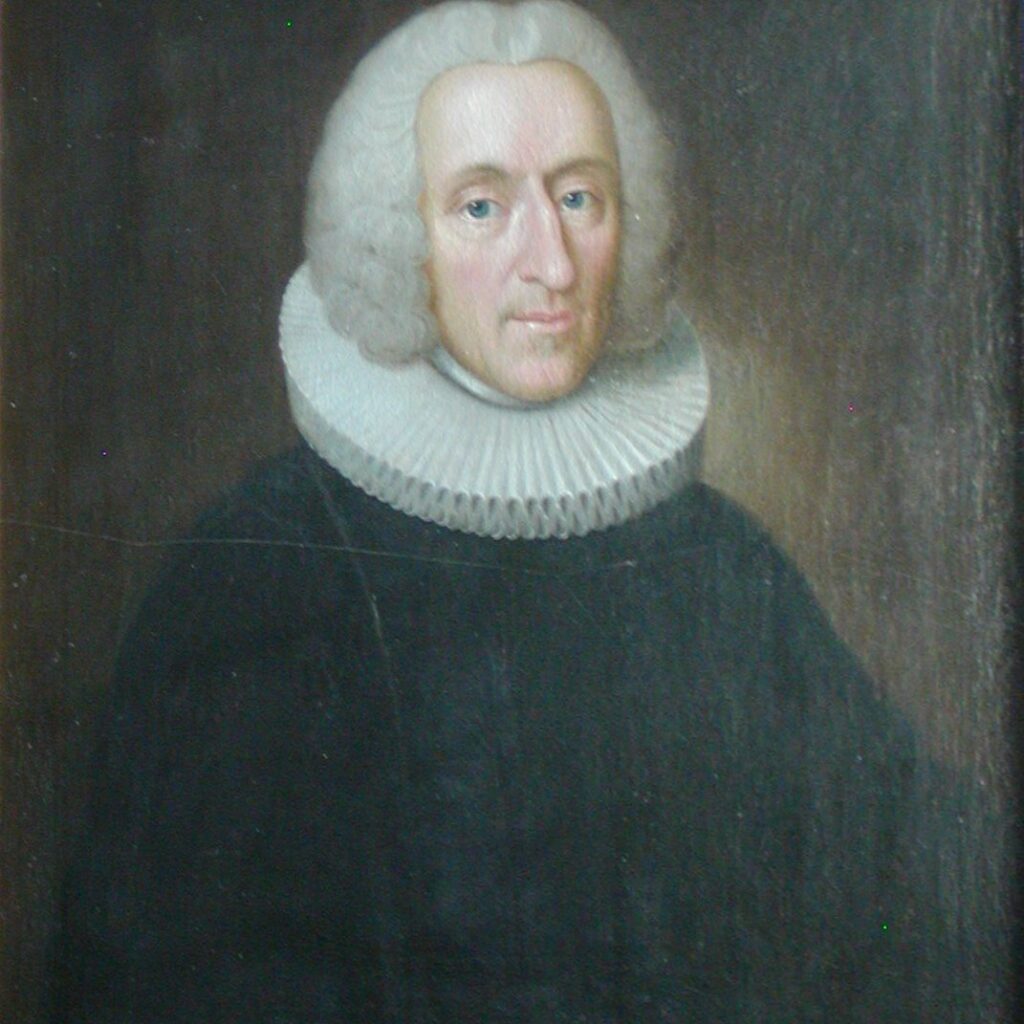
The arrival of Hans Egede in Greenland began a relationship whose terms were understood differently by the people involved. Listening mattered, and listening was never the only force at work.
The voyage and the Island of Hope
In May 1721, Egede and his family left Bergen with the expedition. Nielsen distinguishes weighing anchor from the departure into open water, delayed by the winds. The voyage brought together several vessels, workers, and people intending to establish a base in Greenland. Gertrud and the four children were among the travelers. The project defended for years was now a life aboard ship, dependent on navigation and the resources they had managed to bring.
The passage brought danger. In Nielsen’s account, ice threatened the ships, and one vessel was damaged. The historian conveys Egede’s religious gratitude when conditions allowed them to continue. That relief belongs to the way the pastor understood what he had experienced. Arrival was what the expedition achieved after this crossing, and the tasks of settlement would demand new efforts. At the end of years of waiting, the family entered a stage whose future depended on much more than their wish to remain.
On July 3, 1721, they reached the western coast. The place chosen for their initial settlement became known as the Island of Hope. Shelter had to be prepared and provisions organized before winter. Nielsen describes a house of stone and turf, lined inside with boards. This work preceded the possibility of more sustained missionary activity. The group’s survival depended on turning a landing place into a residence capable of protecting people and storing supplies.
Learning before proclaiming
Egede began gathering words and learning through contact. The memory preserved by Nielsen and by the historical edition of his description emphasizes the questions he asked about objects and names. This work demanded attention and repetition. A word’s meaning could not be obtained simply through the desire to teach. It had to be received from other people, within a relationship in which the missionary also depended on those he proposed to instruct.
His children learned from Inuit children and began helping their father. Living alongside others opened opportunities that formal explanations could not offer in the same way. In the work that followed, communication depended on this collaboration. The local children’s contribution belongs to the mission’s language learning, even when their names were not preserved in the pages consulted. Knowledge circulated among people; it did not arrive ready-made in European hands.
Egede himself would acknowledge the language’s expressive richness and the difficulty of rendering some of its formulations into Danish. He also sought to organize vocabulary and grammatical observations. His published description includes tables and Christian texts in Greenlandic form. These materials show an effort at study and transmission. Yet his ability remained limited, as he admitted when recounting discussions in which he could not answer as clearly as he wished.
Learning also meant understanding how others saw him. In an entry from 1722, Egede explained that people approached him as someone able to heal, associating his role with that of an angakkoq, a traditional religious authority. The local classification did not simply match the meaning he assigned to his own office. His presence was interpreted through existing categories. The encounter required more than replacing one word with another: it involved different ways of recognizing authority, knowledge, and help.
Pooq, Qiperoq, and both sides of the encounter
Pooq wanted to see Denmark. In 1724, he traveled with Qiperoq, who, according to Mads Lidegaard’s biographical entry, had been pressured to accompany him. They participated in events supporting the colonial and missionary enterprise. Qiperoq died; Pooq returned to Greenland and, in 1728, went back to Europe with his family. The following year, he died of smallpox.
The Nationalmuseet preserves a portrait of the two men, painted in Copenhagen in 1724 by Bernhard Grodtschilling at the trading company’s expense. Its description records their participation in demonstrations of kayaking skill. Their representation formed part of the enterprise’s public promotion. These men had names and histories; in Europe, their images also served the interests of those financing the mission.
If you want to stay with the people on both sides of a missionary encounter, the Faith Ablaze app is a place to continue the reading. The member library brings together biographies and studies of mission, translation, and local churches that you can explore and revisit at your own pace. Explore the Faith Ablaze app.
An entry by Egede from April 1726 records Pooq singing about his journey before other Inuit. The pastor says those present admired and praised what they heard. This brief record opens another perspective on the circulation of knowledge. The traveler presented to European audiences could now describe what he had seen to listeners of his own. Greenland was also a place from which Europe was observed, assessed, and described.
His performance before local listeners lets us recognize Pooq as a narrator of what he had encountered. The experience of travel became material for a presentation within his community. Egede recorded the occasion, preserving an account that broadens the field of the story. Alongside European texts about Greenland, there were people who observed the foreigners and described what they saw. Missionary transmission, even shaped by the interests of its writers, preserved signs of this activity and the attention it attracted.
Faith and the use of force
The religious encounter included actions that a biography of faith needs to confront. Egede believed he was combating errors that prevented people from knowing Christ. In his records, that struggle took the form of threats and punishment. The mission’s historical importance does not lessen the weight of these actions. The same pages preserving his dedication also require us to ask what happened when the desire to instruct began demanding the abandonment of practices by force.
In May 1724, describing a visit, Egede recalled threatening death against people who continued acting as angakkut. The record documents the threat without establishing that it was carried out. In January 1725, he reported threatening to bind a religious authority and send him to Europe for punishment. This language went beyond doctrinal disagreement. It placed before the other person the prospect of violence and separation from his homeland.
In February 1728, he recounted an encounter with a female healer who had agreed to visit the colony after being promised payment. Egede accused her of faking a cure and described replacing remuneration with corporal punishment and the threat of harsher treatment. We know the episode through his own presentation, which considers the woman guilty of fraud. That account is not an independent judgment on her practice. It is, however, a record in which the missionary presents force as an instrument of correction.
Books, language, and training successors
In Copenhagen, the Seminarium Groenlandicum became a setting for continuity. Established in 1737, it was intended to prepare people who would work in the mission. Egede participated in language teaching and the guidance of future missionaries and catechists. The experience of someone who had needed to begin learning could now be passed on. Training sought to reduce some of the distance he himself had encountered between the desire to proclaim and the ability to make himself understood.
This work also brought difficulties. Nielsen criticizes an arrangement in which people could be sent without sufficient regard for their abilities, or seek the mission as the first step in a career. This is a later historian’s assessment, within his favorable reading of Egede. It nevertheless indicates the question accompanying training: what preparation and disposition would be necessary for work in such demanding conditions? Language teaching needed to be related to responsibility for people and communities.
In 1740, Egede received the episcopal office associated with Greenland. Nielsen describes duties involving the selection of seminarians, preparation of instructions, and oversight of missionary service. The change of location had not removed him from religious administration. His activity continued within the institutions that had supported and directed the mission. The work required choosing and preparing others, as well as advising about a situation he had known through experience.
Reading the evidence
The surviving record lets us stay with the people on both sides of a missionary encounter. Those details give the account its limits as well as its shape. They let a reader ask what the decisions meant for the people who had to live with them.
Go deeper into the questions raised by Hans Egede with books, study guides, and audio and video resources in the Faith Ablaze app. Your membership also helps our team share more stories that keep the people involved in a mission in view through free articles and YouTube documentaries. Become a member and help keep these stories available.
Selected sources
Pooq og Qiperoq; Pôq (dois verbetes relacionados, orçamento conjunto conservador).
Bernhard Grodtschilling:portræt afPooqogQiperoq,1724. GenstandN.38C.2,assetES-65306.