
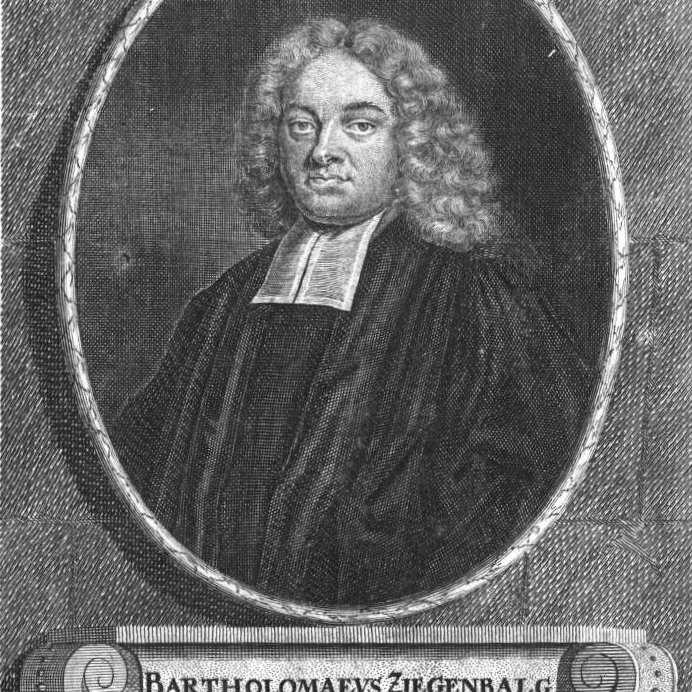
A translator needs more than time at a desk. In Tranquebar, getting a Tamil New Testament into readers’ hands meant working with speakers, readers, paper, and printing equipment.
Learning to listen before teaching
The missionaries began studying Portuguese, spoken by part of the population with whom they interacted, and used written materials already circulating in the region. Tamil posed a further demand: they had to learn its writing, pronunciation, and structure from those who knew them. They hired a teacher to bring his school to their lodging. In the description Fenger preserved, the newcomers learned letters and syllables among children and practiced writing in the sand. The future teachers of the Christian community publicly took the position of learners.
Learning the shapes of the letters still left much unresolved. The teacher did not speak Portuguese, and communicating meaning encountered obstacles that repeating sounds could not overcome. In October 1706, according to Fenger, Aleppa began helping Ziegenbalg. His work included explaining words and making texts accessible. This interpreter’s presence appears in the documentation as an essential part of the process. The competence Ziegenbalg would attain developed through conversations, questions, and explanations that depended on other people’s knowledge.
Learning also began to change the way he looked at the people around him. In testimony the historian reproduced, Ziegenbalg acknowledged that his first assessments of the Tamils had been prejudiced. Contact with educated people and reading their books changed his perception. He was discovering a literary tradition with reflections, narratives, and knowledge that did not fit a newcomer’s hasty impression. The correction matters because it involved more than a larger vocabulary. Learning another language began to require him to reconsider his judgment of its speakers.
Coworkers, readers, and conversation partners
The arrival of new workers in July 1709 included Johann Ernst Gründler, who would become a crucial colleague. He took responsibility within the community and helped sustain a growing range of tasks: schools, teaching, correspondence, organization, and religious care. Later events would show how deeply Ziegenbalg trusted him. When he needed to travel to Europe, he could leave the mission in Gründler’s care; when his own life approached its end, he entrusted him with the documents and leadership of the work.
Not every arrival brought agreement. The accounts preserve disputes within the Lutheran world and European criticism of the mission. Fenger mentions an academic publication from Wittenberg in 1708 accusing the men of self-interest and creating division. These are accusations transmitted by a historian who defended them; publication does not make them facts. Their existence nevertheless shows that Christians debated the initiative, disagreeing about legitimacy, doctrine, and the conduct of the work. The mission also had to explain itself to people who shared its religious tradition.
Correspondence was one means of doing so. Reports from India crossed the ocean and reached readers in other languages. In Halle, letters and diaries underwent editorial selection. Those responsible sought to present the work to a Christian audience and encourage support. These documents preserved valuable news, but the published form has a history of its own. Knowing the missionary through them requires attention to the purpose of the writers and the choices of those preparing the material for print.
The New Testament in Tamil
In October 1708, Ziegenbalg began translating the New Testament. Fenger dates the beginning to the seventeenth, a little more than a month before his imprisonment. After leaving the fortress, he resumed the work and proceeded book by book until March 1711. The sequence matters: learning the language, translating, revising, and printing were stages extending over years. The result did not come from an instant facility or a period of isolation that dispensed with the resources gathered earlier. It was built amid other responsibilities, interruptions, and a need for assistance.
The Greek text served as his basis, and he consulted other Bibles and commentaries on difficult passages. Latin, German, Danish, Portuguese, and Dutch versions were among the resources mentioned in the mission’s history. The task required comparing meanings and finding a way of expressing them that worked in Tamil. An unsuitable word could compromise the understanding of an entire argument. The translator needed to learn to follow the movement of sentences and explain a message whose vocabulary came from another world of texts.
If you want to trace the long process behind a New Testament readers could open, the Faith Ablaze app is a place to continue the reading. The member library brings together biographies and studies of mission, translation, and local churches that you can explore and revisit at your own pace. Explore the Faith Ablaze app.
Ziegenbalg also described the spiritual commitments he considered necessary for translation. Fenger reproduces his account: prayer, obedience to the Word, attention to context, and comparison of interpreters belonged to the work. For him, study needed to reach the scholar’s own life. This conviction gave the task a particular dimension. The man seeking to make a passage understandable to Tamil readers believed he needed to receive it seriously in his own conduct. Translation involved knowledge and continuing examination of the relationship between what he taught and how he lived.
The press, the paper, and the distance
Completing a manuscript did not put books into readers’ hands. A press, type, paper, and workers who knew how to use them were needed. Correspondence opened paths to that support. Anton Wilhelm Böhme published missionary accounts in English in 1709, and the Society for Promoting Christian Knowledge, known as SPCK, began helping the initiative. This collaboration connected European readers with practical needs in India. An account that moved people at a distance could become resources for copying, printing, and distributing texts.
The journey of the press sent by English supporters was difficult. Jonas Fincke, trained for printing work, sailed with the equipment. The ship was captured by the French off the Brazilian coast, released, and continued, but Fincke fell ill and died before reaching India. The press arrived in 1712. A soldier who knew the trade was then hired to operate it. The workshop began functioning because someone assumed a concrete role the missionary could not fill alone. The history of publication includes this worker and the loss of the man who never arrived.
Tamil type came through another line of collaboration. Supporters in Halle supplied the necessary characters. Johann Gottlieb Adler contributed as a typefounder and mechanic, working to adapt resources to the mission’s conditions. Smaller characters helped address the cost and shortage of paper. There was also an attempt to manufacture paper in Porayar, later abandoned. Printing depended on material solutions that had to be tested, corrected, or set aside. The desire to spread the Word encountered the patient labor of those who had to make a page possible.
The contradictions memory must confront
Ziegenbalg’s writings require admiration to be accompanied by critical attention. In recognizing the value of Tamil literature, he corrected some of his initial prejudices. Yet he continued describing other religions through harsh judgments. His work on their deities emerged from questions, correspondence, and collaboration, while its preface retained the purpose of challenging beliefs and promoting conversion. Both dimensions are documented. A willingness to learn could produce real understanding without eliminating every assumption through which the missionary interpreted his conversation partners.
Kaarsholm, following Liebau’s research, connects letters from 1706 and 1710 with purchasing enslaved people, including children, for the mission. Known here through these studies, this evidence prevents us from portraying Ziegenbalg as a full opponent of slavery. Baptism does not establish emancipation.
Caste also calls for caution. Oluf Schönbeck shows how opposing positions invoked Ziegenbalg’s memory in later debates. Declaring equality and demonstrating its realization in daily life are distinct questions.
The first community included people living under slavery, and the schools offered support and instruction within unequal social relationships. Missionary accounts themselves allow us to recognize this condition, although they often organize events around their significance to the men sent out. A responsible biography needs to keep the participants visible. An institution’s progress and each person’s experience within it do not fully explain one another. Where someone’s voice has not been preserved, that silence must limit the certainty of our conclusions.
Reading the evidence
The surviving record lets us trace the long process behind a New Testament readers could open. Those details give the account its limits as well as its shape. They let a reader ask what the decisions meant for the people who had to live with them.
Go deeper into the questions raised by Bartholomäus Ziegenbalg with books, study guides, and audio and video resources in the Faith Ablaze app. Your membership also helps our team share more stories that keep the people involved in a mission in view through free articles and YouTube documentaries. Become a member and help keep these stories available.
Selected sources
History of the Tranquebar Mission,Tranquebar:EvangelicalLutheranMissionPress,1863.