
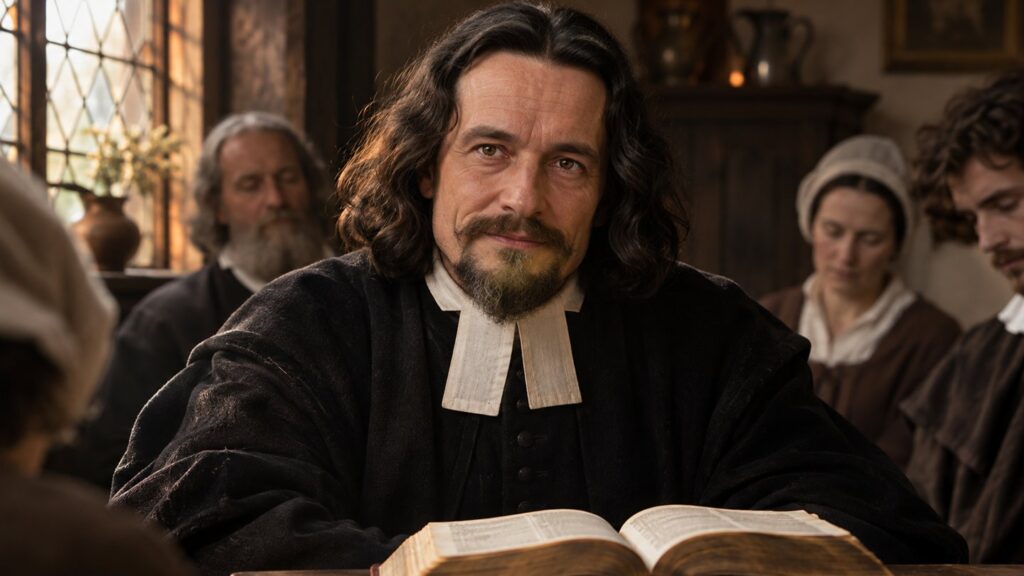
A proposal for renewal becomes concrete when readers can picture people gathering to open Scripture together. That change of scale is important to Philip Jacob Spener’s plans for the church.
Frankfurt: Longing Becomes a Proposal
In 1666, Spener began his ministry in Frankfurt as a pastor and leader of the city’s Lutheran clergy. Preaching and catechetical instruction held a central place in his work. Tschackert describes his efforts to help hearers understand Scripture in sequence and to give new energy to instruction in the catechism. His concern for renewal found expression in repeated tasks: explaining, teaching, preparing, and teaching again.
He also promoted confirmation and the preparation of young people for participation in the Lord’s Supper. The practice had earlier precedents; his contribution belonged to the effort to develop and strengthen it. The same concern for instruction would appear in his explanation of Christian doctrine following the order of Luther’s Small Catechism, published in 1677. The church’s formation could not depend solely on extraordinary moments. It required foundations that were understood and revisited.
An editorial opportunity gave his concerns a wider public expression. Invited to write a preface for a new edition of Johann Arndt’s collection of sermons, he brought together proposals for improving the church. In 1675, this text began circulating as Pia Desideria, a Latin title expressing pious desires. The work’s full title spoke of a heartfelt desire for a God-pleasing improvement of the true evangelical church.
In the preface to the separate edition, signed September 8, 1675, Spener explained that colleagues had heard the manuscript, contributed observations, and approved its purpose. He also reported that readers wanted the text without having to purchase Arndt’s entire volume. This process reveals a pastor in conversation with other ministers and readers. His proposal took shape through writing, receiving observations, and circulating a concern beyond his immediate community.
Opening Scripture in Community
Before Pia Desideria reached the public, an experiment had already begun in Frankfurt. In 1670, Spener welcomed meetings for edification that became known as collegia pietatis. Tschackert describes a small beginning in the pastor’s study, followed by growing interest. In the early years, devotional books provided material for discussion; from 1675 onward, according to this account, the New Testament took their place.
The gathering brought instruction close to the lives of its participants. Words heard in preaching could be revisited, a passage could raise a question, and learning found an opportunity for dialogue. There is enduring strength in this attention: a community’s spiritual life also depends on what happens after the sermon ends. Understanding requires time, questions, and assistance. Spener sought to give this continuing care an organized form.
The meetings nevertheless carried the inequalities of their setting. The biographer records the presence of men and women of different social positions, but explains that most listened and that educated men usually spoke. Women sat where they were out of the men’s sight and listened. This information must remain part of the story. Expanded lay participation did not mean that social and gender hierarchies had disappeared.
In Pia Desideria, the first reform proposal called for God’s Word to be present more abundantly among Christians. The author observed that even many years of sermons on selected passages left extensive portions of the Bible unfamiliar to the congregation. He therefore proposed household reading, public reading of biblical books, and meetings for discussing Scripture. These practices were intended to expand the instruction already taking place.
Grace That Awakens Love
The second proposal in Pia Desideria called Christians to exercise their spiritual priesthood. Drawing on Luther’s heritage, Spener reminded them that prayer, thanksgiving, assistance, instruction, and encouragement belonged to the life of believers. Care for one’s neighbor could not be transferred entirely to the pastor. Certain responsibilities needed to be accepted in the household and in ordinary daily relationships.
This proposal retained a distinction between the public service of appointed ministers and the activity of other Christians. Spener believed that the responsible exercise of the community’s gifts would assist pastoral ministry. One person could not meet all the needs of many hearers. The congregation needed to learn to care: teaching what it knew, comforting those who suffered, offering brotherly correction, and seeking assistance when necessary.
If you want to follow the move from a written proposal to habits a congregation could practice, the Faith Ablaze app is a place to continue the reading. The member library brings together biographies and studies of Christian renewal that you can explore and revisit at your own pace. Explore the Faith Ablaze app.
The third proposal moved from responsibility to the way it should be lived. Christian knowledge needed to produce practice, especially love. Rather than leave that word in the realm of intentions, the author addressed demanding situations. He recommended examining the motives behind a good deed, guarding against revenge, and seeking opportunities to benefit someone who had caused offense. Love should reach even an enemy and transform the actual response to injury.
This emphasis can be misunderstood if separated from what Spener wrote about salvation. He confessed that a person is saved through faith alone and that works belong to gratitude as the fruits of that faith. In his account, a changed life did not purchase God’s favor. He wanted to challenge the empty assurance of those who claimed faith in Christ while remaining deliberately indifferent to the evil they practiced.
Hope, Conflict, and the Refusal to Abandon the Church
The desire to renew the church carried a difficult question: could one expect it to improve within history? In Pia Desideria, Spener answered with hope. His reading of Romans 11 led him to expect a future conversion of Israel; his interpretation of Revelation included the fall of papal Rome’s power. From these expectations, he maintained the possibility of a happier condition for the church.
This hope must be understood within its historical limits. It was a confessional and polemical Christian reading of biblical texts. The book used harsh language against Rome and did not begin from a contemporary understanding of relations between religions. In recounting it, we can recognize both its energy for work and the limits of its outlook. Spener’s expectation belongs to his theology; historical narration does not turn it into a verified prediction of everything that followed.
He himself acknowledged other interpretations and the possibility of misunderstanding a prophecy before its fulfillment. Conviction did not prevent him from admitting this difficulty. At the same time, he insisted that awaiting God’s action involved working. Hope should move Christians to accomplish the good within their reach, even when they could not achieve every desired result.
The program also faced the objection that perfection would be impossible in this life. Spener admitted that Christians would never reach a condition in which nothing remained to be improved. In his account, those who sincerely advanced recognized more clearly what they still lacked. This admission made room for patient reform, capable of seeking progress without announcing that the community had already become free of every failure.
Berlin and the Paths to Halle
Spener began his Berlin ministry in 1691 as provost of St. Nicholas and a member of Brandenburg’s consistory. He returned to a community larger than Dresden’s court congregation. Preaching, catechetical instruction, school supervision, and administrative responsibilities formed part of his work. The position also kept him in contact with people seeking guidance and with candidates preparing for ministry.
Tschackert reports that he welcomed future pastors into his home, offering companionship and instruction. He also records Spener’s assistance with efforts to care for Berlin’s poor. These aspects bring institutional history close to ordinary life. Renewal projects needed people prepared to teach and attention to others’ material needs. Spiritual service touched concerns reaching the door of the city and the household.
One of the most enduring results of his activity during this period was his support for the formation of Halle’s theological faculty. The university was inaugurated in 1694. Joachim Justus Breithaupt and Francke were among those associated with the beginning of theological teaching; Paul Anton would join them. Appointments and institutional developments involved political decisions, educational needs, and the work of several men. Spener helped make room for people who shared his concerns.
Halle created new possibilities for ministerial training and for Francke’s work. Each person’s contribution must remain visible: Spener’s support mattered, and Francke developed his own work. A history attributing everything to one name weakens our understanding of collaboration. The legacy could grow because others accepted responsibilities, built institutions, and responded to concrete needs.
Reading the evidence
The surviving record lets us follow the move from a written proposal to habits a congregation could practice. Those details give the account its limits as well as its shape. They let a reader ask what the decisions meant for the people who had to live with them.
Go deeper into the questions raised by Philip Jacob Spener with books, study guides, and audio and video resources in the Faith Ablaze app. Your membership also helps our team share more stories that follow the work a movement leaves to its communities through free articles and YouTube documentaries. Become a member and help keep these stories available.
Selected sources
Spener, Philipp Jakob, Neue Deutsche Biographie 24 (2010), pp.659–661.
Spener, Philipp Jakob, Allgemeine Deutsche Biographie 35 (1893), pp.102–115.
Pia Desideria, Frankfurt: Johann David Zunner / Johann Dieterich Friedgen, 1676.