
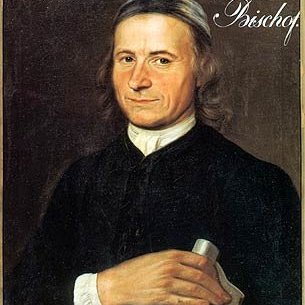
The responsibilities of David Nitschmann could include traveling overseas and tending to the practical future of a congregation. Those obligations put him close to decisions that later memory could easily overlook.
The Saint Thomas Mission
In August 1732, Nitschmann left Herrnhut with Leonhard Dober, leaving Rosina and the children behind. David had been sent to help establish the work and would remain on the island temporarily; Dober was preparing for a longer stay. The carpenter's task was to make the beginning of that missionary presence possible by offering his labor and his experience of travel.
His own account describes Zinzendorf's assistance at the beginning of the journey and a stop in Wernigerode, where he received encouragement from Steinmetz and the countess. In Copenhagen, the question was practical: how would they support themselves in Saint Thomas? Nitschmann remembered saying they intended to work with the Africans. When someone objected that the white inhabitants would not allow it, he offered his trade as a carpenter. Dober could assist him. The work he had learned in Herrnhut became central to his answer.
This passage does not describe the two missionaries being sold as slaves. It describes their search for the means to travel and support themselves. Nitschmann said he negotiated passage with a captain and received help from people in Denmark, including Pless, Martens, and Grothausen. The crossing was remembered as long and demanding. The service they hoped to undertake depended on a ship, food, supporting relationships, and the ability to work. Their religious decision had to pass through each of those conditions.
The Freedom He Did Not Defend
According to the printed autobiography, Princess Hedwig and Pless asked Nitschmann about the mission in Saint Thomas and the prospects for conversions. He answered favorably. They then told him of their intention to purchase freedom for those who converted. His response was opposed. Nitschmann wrote that he advised against the proposal because, in his judgment, it would produce hypocrites: people who approached the faith to obtain a change in their condition.
The reason he recorded shows the extent of the problem. To protect what he understood as religious sincerity, he accepted that converts would remain enslaved. He appealed to an interpretation of Paul to argue that they should remain in their condition and serve faithfully. He added that this would help win the goodwill of owners, who would be pleased to see more people converting. The account also says that he communicated his position to Zinzendorf and that the count agreed.
That position makes it impossible to describe him, on the basis of this episode, as an advocate of emancipation. It also prevents religious closeness to Africans from being taken as sufficient evidence of equality in social relations. Someone could proclaim that Christ received sinners while opposing a concrete opportunity for freedom for people who were enslaved.
Recognizing this does not require denying the work that brought him to the island. It requires understanding its limit. The man who left his homeland to serve also assessed the situation through concerns that gave weight to owners' approval and the risk of conversions for personal advantage. His narrative records those reasons; it does not record there the voices of the people whose freedom was at stake. Their silence cannot be filled with a consent we do not possess, or with the idea that spiritual benefit made their condition unimportant.
A Carpenter Receives the Episcopate
After returning to Herrnhut, Nitschmann continued to receive assignments. In 1734, he was involved in considering a Moravian settlement in Holstein. The following year brought a new responsibility. On March 13, 1735, in Berlin, Daniel Ernst Jablonski ordained him a bishop. The authorization connected a worker of the renewed community with an institutional continuity preserved by the Brethren in Poland. Its significance extended beyond a personal distinction in the carpenter's life.
The certificate preserved in a digital image helps explain the office. It was issued on June 14, 1737, but expressly refers to the ordination of 1735. It mentions the laying on of hands and prayer, with the knowledge and consent of Christian Sitkovius. The distinction between the dates matters: the later document does not move the ceremony to 1737.
If you want to follow the obligations that arrived after a mission began, the Faith Ablaze app is a place to continue the reading. The member library brings together biographies and studies of mission, translation, and local churches that you can explore and revisit at your own pace. Explore the Faith Ablaze app.
The stated responsibilities included conducting visitations and ordaining pastors and servants of the churches. This authority was directed toward communities far from one another. The need for a ministry that could sustain religious life beyond Herrnhut helps explain the scope of the office. The bishop was to cross distances, accompany workers, and take part in their preparation and sending. The title found its meaning in tasks that reached other people.
The choice can also be considered in light of his earlier life. Nitschmann had helped maintain connections with Moravia, traveled to England, undertaken assignments in Livonia, and brought his labor to Saint Thomas. Zinzendorf's praise, transmitted in the memoir, associates the choice with contributions he saw in him. In the assessment preserved by the memoir, the new responsibility was connected with service already tested.
Caring for a Congregation's Future
In Savannah, Nitschmann's service joined that of August Gottlieb Spangenberg and the workers who had prepared the place. Fries describes the distribution of responsibilities, the formation of small groups for religious fellowship and care, and the celebration of Communion. The community sought to attend to its spiritual life and material needs. The bishop had been sent for a limited stay. Part of his responsibility was to help the congregation avoid depending on his presence at every subsequent step.
The encounter with Anton Seifert, presented at the opening of this story, belongs in that context. Fries places his ordination in March 1736. The congregation's choice and the warning against pride joined responsibility with the character of service. Nitschmann's work found expression in preparing someone else to care for others. A ministry that needed to reach distant places could not be sustained solely by the movements of its first bishop.
The accounts' terminology requires care. Wesley and Ingham referred to Seifert as the congregation's bishop; Fries distinguishes that language from the Moravian episcopate and explains his ordination as that of a deacon. The offices were still being organized: there was a congregation, a person chosen to serve it, and an ordination conducted there.
The mission also depended on encounters beyond the European world. Nitschmann accompanied Spangenberg, Wesley, and Andrew Dober to Mary Musgrove's area, where matters of language and contact with Tomochichi were being considered. Fries presents him as interested in speaking with the Indigenous leadership. This undertaking shows a need for relationship and learning. The intention to proclaim the faith did not make the people, knowledge, and decisions of those already living there dispensable.
Bethlehem: A Place Built by Many People
Nitschmann was involved in the negotiations and beginnings of Herrnhaag in 1738. The carpenter and bishop took part in projects in which religious life needed physical space. Soon another assignment would take him back to Pennsylvania. Joseph Mortimer Levering's history places his arrival in Nazareth in December 1740, accompanied by his uncle David Nitschmann, Anna Nitschmann, and other members of the party. Anna was his uncle's daughter, not the bishop's.
The project was to create a settlement that could support teaching, visitation, and mission. Finding somewhere to live was only part of the question. The community needed a base for workers who would serve in different places. Peter Boehler introduced Nitschmann to Nathanael Irish, and conversations about land on the Lehigh advanced. Levering shows a network of decisions and contacts: Bethlehem's history did not begin with the protagonist's solitary achievement.
Preparations for construction began before the purchase agreement was concluded. Levering associates the first cutting of timber with the uncle, known as Father Nitschmann, and Martin Mack, together with another helper. The distinction matters. The bishop helped direct the undertaking, but his name should not absorb the work of the men who entered the property and began building. The continuity between leadership and manual labor does not erase the distinction between those who performed each task.
Reading the evidence
The surviving record lets us follow the obligations that arrived after a mission began. Those details give the account its limits as well as its shape. They let a reader ask what the decisions meant for the people who had to live with them.
Go deeper into the questions raised by David Nitschmann with books, study guides, and audio and video resources in the Faith Ablaze app. Your membership also helps our team share more stories that keep the people involved in a mission in view through free articles and YouTube documentaries. Become a member and help keep these stories available.
Selected sources
Inventory of the records of the Papers of David Nitschmann (Bishop),1728–1756,2005.
David Nitschmann’s Bishop’s Ordination,1735. ThisMonthMoravianHistory51,March2010.
Památná místa Moravských bratří: Růžový palouček.
Nitschman, Allgemeine Deutsche Biographie23(1886),artigo de família,pp712–714; DeutscheBiographie.